
Robotic Depalletizing Systems
Automating Product Unloading and Material Flow at the Start of Production Lines
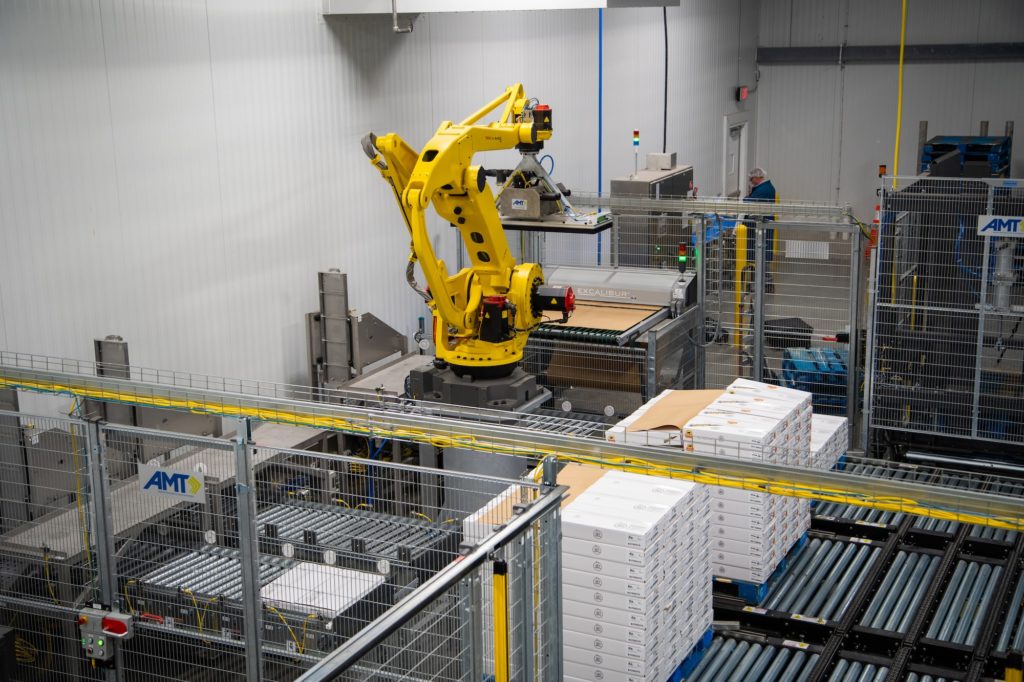
Robotic depalletizing systems automate the process of unloading products from pallets and preparing them for downstream manufacturing, packaging, or distribution processes. These systems are commonly deployed at the front of production lines and in warehouse environments where consistent product flow and labor efficiency are critical.
AMT designs and integrates robotic depalletizing systems as part of complete material handling solutions. Each system is engineered to manage product variability, coordinate with upstream logistics, and deliver consistent, controlled product presentation to downstream processes.
Depalletizing is a critical control point in automated systems. Poorly designed depalletizing operations can introduce variability, reduce throughput, and create downstream bottlenecks. AMT approaches depalletizing as a system-level engineering problem to ensure reliable performance across the entire production flow.
When Manufacturers Invest in Robotic Depalletizing
Manufacturers and distribution operations typically automate depalletizing when manual unloading limits throughput, creates labor challenges, or slows the movement of materials into production. Robotic depalletizing systems improve efficiency by automatically unloading pallets, handling mixed product loads, and delivering products to downstream processes with greater speed and consistency.
Manufacturers commonly invest in robotic depalletizing to:
- Eliminate manual pallet unloading as a production bottleneck
- Address labor shortages in receiving and material handling operations
- Increase throughput for high-volume production or warehouse environments
- Handle mixed-SKU, mixed-layer, or randomly stacked pallet loads
- Improve worker safety by reducing repetitive lifting and awkward motions
- Supply production lines with a consistent flow of materials
- Integrate depalletizing with conveyors, vision systems, ASRS, robotic induction, or other automated material handling equipment
Whether supporting manufacturing, warehousing, or distribution operations, robotic depalletizing helps improve material flow, increase operational efficiency, and create a more scalable receiving process.
What Is Robotic Depalletizing?
Robotic depalletizing is the automated process of removing products from pallets using industrial robots. These systems separate, orient, and transfer products from pallet loads into conveyors, processing lines, or storage systems.
Depalletizing is often followed by:
- Singulation
- Decanting
- Pallet breakdown
- Storage
- Delayering
- Picking
These systems replace manual unloading operations, improving throughput, consistency, and workplace safety while reducing labor requirements.
Common Depalletizing Applications
Robotic depalletizing systems are used in a range of production and logistics environments:
Case Depalletizing
Removing uniform cases from pallets and feeding them into production or packaging lines.
Mixed-Load Depalletizing
Handling pallets with varying product sizes, shapes, and configurations.
Decanting for Warehouse Operations
Transferring products from pallets into totes or bins for automated storage and retrieval systems (ASRS).
High-Speed Line Feeding
Supporting production lines that require continuous, high-throughput product input.
Layer and Row Picking
Removing full layers or partial rows depending on product configuration and downstream requirements.
Integrated Depalletizing System Design
Depalletizing systems are integrated with upstream logistics and downstream processing equipment to maintain consistent product flow.
Typical system integration includes:
- Pallet infeed and positioning
- Layer detection and product identification
- Conveyor systems and product routing
- Sorting and distribution systems
- Integration with ASRS or production lines
AMT evaluates the entire material flow when designing depalletizing systems. This includes how pallets are received, how products are separated, and how they are introduced into downstream processes. System design focuses on maintaining throughput while minimizing product disruption and handling variability.
Depalletizing Challenges in Warehouse Applications
Depalletizing in warehouse and distribution environments introduces additional complexity due to product variability and system speed requirements. Common challenges include:
Case Size Variability
Differences in box dimensions require adaptable tooling and picking strategies.
Printed Graphics and Packaging Variation
Visual inconsistencies can impact detection accuracy in vision systems.
Pick Pattern Optimization
Systems must determine the most efficient grouping of products for each pick.
High SKU Volume
Large numbers of product variations require flexible system logic and adaptive controls.
End-of-Arm Tooling Constraints
Tooling must be positioned precisely to avoid unintended picks and ensure stable handling.
These challenges require integration of machine vision, sensor technology, and advanced control systems to maintain throughput and accuracy in high-speed environments. Vision systems identify case location, orientation, and grouping to optimize pick selection and maximize throughput.
Engineering for Product, Process, and Environmental Challenges
Depalletizing systems must accommodate a wide range of real-world variables that impact performance:
- Irregular pallet loads with inconsistent stacking patterns
- Variation in product size and packaging
- Unstable or shifted loads during transport
- Mixed product configurations within a single pallet
- Environmental conditions such as temperature and humidity
These challenges require systems that can adapt dynamically to changing conditions. Robotics, sensors, and vision systems are configured to detect product position, orientation, and condition in real time.
System design must ensure reliable product handling without compromising throughput or introducing errors into downstream processes.
AI-Enabled Depalletizing Systems
Advanced depalletizing applications require systems that can make real-time decisions based on product variability.
AMT has developed AI-enabled depalletizing systems that use machine vision and intelligent algorithms to optimize product handling and placement. These systems are designed to:
- Identify product size, shape, and orientation
- Determine optimal picking strategies
- Adapt to incomplete or irregular pallet layers
- Maximize efficiency in downstream processes
Machine learning models are used to evaluate product configurations and optimize pick strategies, allowing systems to adapt to new or previously unseen product arrangements.
Example: Robotic Induction System (ROBiN)
AMT’s ROBiN system integrates depalletizing robots, machine vision, and AI-driven decision-making to support high-throughput warehouse operations. The system evaluates incoming pallet configurations and dynamically determines how products should be handled and distributed.
In one application, the system was designed to process more than 3,000 cases per hour while maximizing tote utilization and adapting to variable product conditions.
Example: Automated Depalletizing for Regulated Environments
AMT implemented an automated depalletizing and material handling system for a sterilization facility requiring strict process control and traceability.
The system uses robotic depalletizing to orient products for processing, followed by automated transfer and re-palletizing. Integrated tracking and data logging ensure compliance with regulatory requirements while maintaining consistent product flow.
The solution reduced manual handling, improved throughput, and minimized the risk of contamination in a controlled environment.
See a Robotic Depalletizing System in Operation
This example demonstrates how robotic depalletizing systems can be used to unload products efficiently while maintaining consistent flow into downstream processes.
Performance and Throughput
Robotic depalletizing systems are designed to meet specific throughput requirements based on application needs.
System performance depends on:
- Product type and variability
- Pallet configuration
- System architecture
- Integration with downstream processes
High-throughput systems can process thousands of units per hour when properly integrated with conveyors, vision systems, and control logic.
Benefits of Robotic Depalletizing Systems
Robotic depalletizing systems provide measurable operational improvements:
Consistent Product Flow
Maintains steady input into production or storage systems.
Reduced Labor Requirements
Minimizes manual unloading operations.
Improved Workplace Safety
Reduces repetitive lifting and handling of heavy products.
Adaptability to Product Variation
Handles mixed loads and changing product configurations.
Integration with Automated Systems
Supports ASRS, packaging lines, and material handling systems.
FANUC Robotic Depalletizing Technology
FANUC Robotic Depalletizing in Operation
AMT integrates FANUC robotic platforms for depalletizing applications requiring reliability, repeatability, and high payload capacity. These systems are configured to handle a wide range of products and pallet configurations in industrial environments.
Frequently Asked Questions
What is the difference between palletizing and depalletizing?
Palletizing involves stacking products onto pallets, while depalletizing involves removing products from pallets and preparing them for further processing.
What is decanting in automation?
Decanting is the process of transferring products from pallets into totes or bins, often used in warehouse and ASRS applications.
Can depalletizing systems handle mixed products?
Systems can be designed to handle mixed-product pallets using vision systems and intelligent control logic to identify and sort products.
How fast can robotic depalletizing systems operate?
Throughput depends on system design and product characteristics. High-performance systems can process thousands of units per hour in optimized applications.
Related Automation Solutions
- Robotic Palletizing Systems
- Robotic Case Packing Systems
- End-of-Line Automation Systems
- Robotic Material Handling Systems