
Robotic Palletizing Systems
Automating End-of-Line Packaging with Scalable, High-Performance Systems
Robotic palletizing systems automate the process of stacking products such as cases, bags, trays, and containers onto pallets for storage or shipment. These systems are deployed in manufacturing and distribution environments where throughput, consistency, and labor efficiency directly impact operational performance.
AMT designs and integrates robotic palletizing systems as part of complete automation solutions. Each system connects upstream packaging processes with downstream material handling and shipping operations. Industrial robots, custom end-of-arm tooling, and integrated controls are configured to meet defined production requirements while maintaining flexibility for product variation and future expansion.
AMT approaches palletizing as a system-level engineering problem. The objective is not only to automate stacking, but to ensure the entire production flow operates efficiently without introducing bottlenecks or variability.
When Manufacturers Invest in Robotic Palletizing
Manual palletizing often becomes a bottleneck as production volumes increase, labor becomes more difficult to staff, or workplace safety concerns grow. Robotic palletizing systems help manufacturers automate end-of-line operations while improving throughput, consistency, and pallet quality.
Manufacturers typically invest in robotic palletizing when they need to:
- Eliminate manual palletizing as a production bottleneck
- Address labor shortages or reduce repetitive manual lifting
- Increase throughput to meet growing production demands
- Build consistent, stable pallet loads for shipping and distribution
- Improve worker safety by reducing repetitive motion and heavy lifting
- Handle multiple product sizes, pallet patterns, or packaging formats
- Integrate palletizing with case packing, labeling, conveyors, or stretch wrapping systems
Whether automating a single production line, implementing a collaborative palletizing cell, or integrating multiple end-of-line packaging operations, robotic palletizing provides a scalable solution that improves efficiency while supporting future production growth.
What Is Robotic Palletizing?
Robotic palletizing is the automated process of picking, orienting, and stacking products onto pallets using industrial robots.
These systems replace manual palletizing operations, improving throughput, consistency, and workplace safety. Robotic palletizing systems can be configured to handle a wide range of products and packaging formats, including:
- Corrugated cases
- Bags (pet food, grain, powders)
- Trays and totes
- Pails and rigid containers
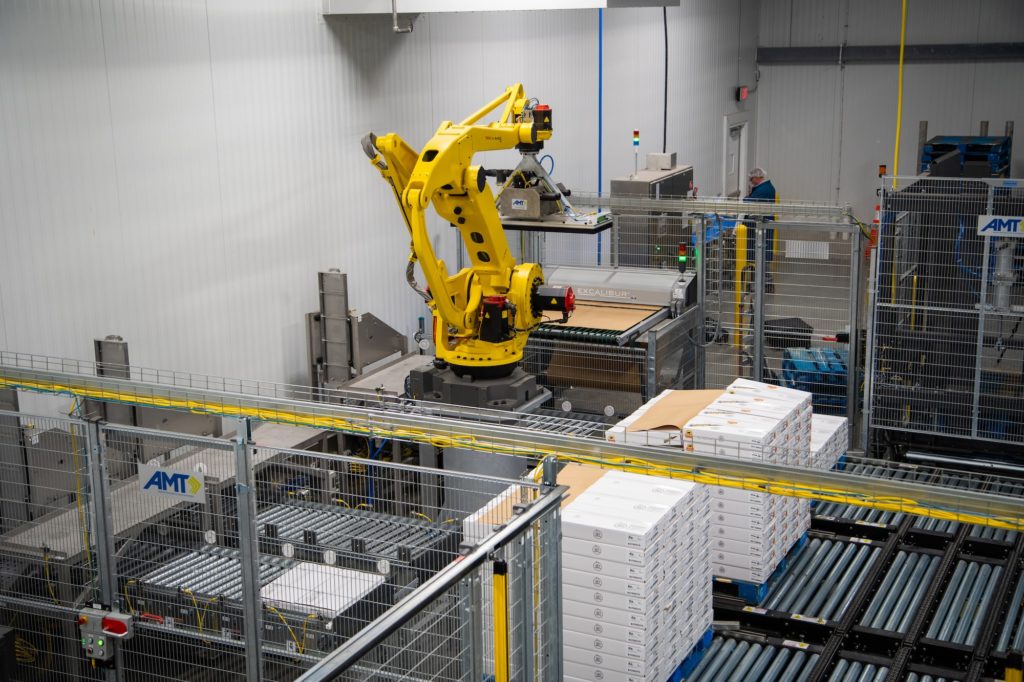
Common Palletizing Applications
Robotic palletizing systems are used across a range of production environments:
Case Palletizing
Stacking uniform boxes in defined patterns for consistent load building.
Bag Palletizing
Handling flexible or deformable packaging where product stability must be maintained during transfer.
Mixed SKU Palletizing
Building pallets with varying product sizes, weights, and configurations within a single load.
High-Speed Palletizing
Supporting high-throughput production lines with cycle time and coordination requirements.
Multi-Line Palletizing
Consolidating multiple upstream production lines into shared palletizing systems.
Integrated Palletizing System Design
Palletizing systems are integrated with upstream and downstream processes to create a coordinated production environment. Typical system integration includes:
- Case erecting
- Packing and sealing
- Labeling and barcode verification
- Conveyor routing and product sortation
- Pallet handling and stretch wrapping
AMT evaluates the full production workflow when designing palletizing systems. This includes analyzing product flow, equipment interfaces, and system constraints to prevent bottlenecks at transition points. The result is a system that improves overall line performance rather than optimizing a single operation.
Engineering for Real-World Product Challenges
Palletizing system design is driven by product characteristics and process variability. Each application requires evaluation of factors that directly affect system performance and tooling design:
- Product weight and load stability
- Center of gravity and load shifting during handling
- Package porosity affecting vacuum performance
- Product deflection under load
- Variation in size, shape, and packaging materials
- Environmental conditions such as temperature and humidity
These variables determine robot selection, end-of-arm tooling configuration, and system control strategy. Systems must be designed to operate reliably across the full range of expected conditions.
System Components
A robotic palletizing system typically includes:
- Industrial Robots
AMT is a FANUC Level V Authorized System Integrator, deploying FANUC robotic platforms for palletizing applications requiring high payload capacity, speed, and reliability. - End-of-Arm Tooling (EOAT)
Custom tooling is engineered to handle specific product characteristics, including variable sizes, weights, and packaging types. - Conveyor Systems
Transport products between upstream processes and palletizing cells while maintaining proper spacing and orientation. - Pallet Handling Equipment
Includes pallet dispensers, pallet conveyors, slip sheet feeders, and stretch wrapping systems.
Control Systems and HMI
Coordinate system operation, manage product tracking, and enable operators to adjust pallet patterns and system parameters.
Collaborative Palletizing Systems
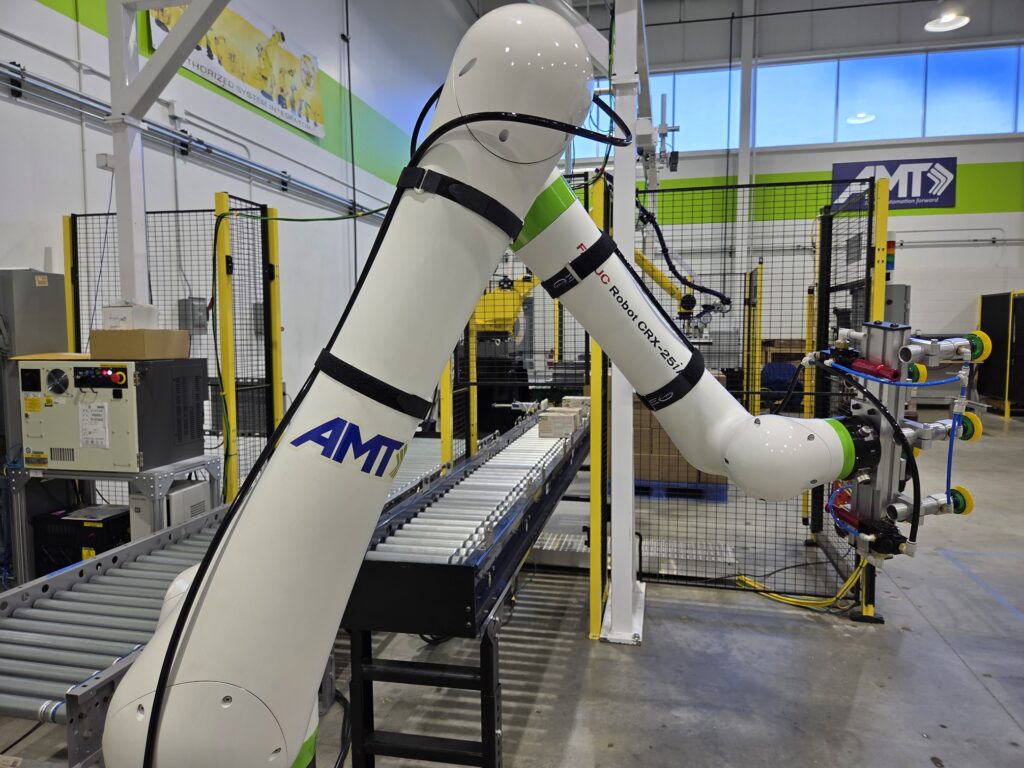
For applications with lower throughput requirements or limited floor space, collaborative robot palletizing systems provide a flexible alternative to traditional industrial robots.
AMT’s Maverick palletizing system is built on the FANUC CRX collaborative robot platform and is designed for quick deployment, ease of use, and safe operation alongside personnel. These systems are well suited for facilities looking to automate manual palletizing without major infrastructure changes.
Example: Automated Palletizing System for Refrigerated Production
AMT implemented a fully automated palletizing system for a manufacturer of refrigerated pet food operating in a cold, high-moisture environment.
The system uses multiple FANUC robots to perform dynamic layer building and full-layer palletizing. Products are conveyed through an integrated system that includes layer formation, pallet loading, and automated wrapping. The system accommodates a wide range of product sizes and pallet configurations without requiring manual intervention.
The automation eliminated manual palletizing, reduced ergonomic risk, and enabled the facility to scale production while maintaining consistent throughput.
Example: High-Speed End-of-Line Palletizing System
AMT designed a high-speed palletizing and pack-out system for a food processing facility, integrating conveyors, barcode-driven product routing, and multiple robotic palletizing cells.
The system coordinates product flow from packaging through sortation and palletizing, with multiple robots building pallets simultaneously. Automated pallet handling and wrapping complete the process, creating a continuous, high-throughput operation.
See a Robotic Palletizing System in Operation
This example demonstrates how robotic palletizing systems are integrated into high-throughput production environments, coordinating product handling, sortation, and pallet building within a single system.
Performance and Throughput
Robotic palletizing systems are engineered to meet defined production targets. Typical performance ranges include:
- 10–30 cases per minute for standard applications
- Higher throughput for multi-robot or optimized systems
Performance depends on product characteristics, system configuration, and coordination with upstream and downstream processes.
In one AMT system upgrade, cycle time was reduced by 67%, improving throughput while maintaining system reliability and equipment longevity.
Benefits of Robotic Palletizing Systems
Robotic palletizing systems provide measurable operational benefits:
- Increased Throughput
Systems are designed to meet production targets and eliminate bottlenecks. - Reduced Labor Requirements
Automation reduces reliance on manual palletizing operations. - Improved Workplace Safety
Eliminates repetitive lifting and reduces ergonomic risk. - Consistent Pallet Quality
Ensures repeatable pallet patterns and stable loads. - Scalability and Flexibility
Systems can be adapted to support new products and changing production requirements.
FANUC Robotic Palletizing Technology
FANUC Palletizing in Operation
AMT integrates FANUC robotic platforms for palletizing applications requiring high payload capacity and repeatable performance. These systems support a wide range of palletizing configurations and are commonly deployed in high-throughput manufacturing environments.
Frequently Asked Questions
What products can be palletized with robotic systems?
Robotic palletizing systems can handle cases, bags, trays, totes, and rigid containers. Tooling and system configuration are designed to accommodate product variation.
How fast can robotic palletizing systems operate?
Typical systems operate between 10–30 cycles per minute. Higher throughput can be achieved depending on system design and application requirements.
Can robotic palletizing systems handle multiple products?
Systems can be configured for mixed-product environments, supporting multiple SKUs, pallet patterns, and packaging formats within a single system.
What factors affect palletizing system design?
System design is based on product characteristics, throughput requirements, environmental conditions, and integration with upstream and downstream processes.
Related Automation Solutions
- Robotic Depalletizing Systems
- Robotic Case Packing Systems
- End-of-Line Automation Systems
- Robotic Material Handling Systems